

Introduction: Why Satellite Internet Is Suddenly Everywhere
A few years ago, satellite internet sounded like one of those technologies that only scientists or people living in the middle of nowhere would use. Now it’s showing up in tech news almost every week.
And honestly, it makes sense.
There are still so many places where getting a stable internet connection feels impossible. Maybe fiber hasn’t reached your area yet. Maybe mobile data works fine one day and completely slows down the next. If you’ve dealt with that frustration before, you already understand why people are getting interested in satellite internet.
The idea is pretty simple. Instead of depending on underground cables, the internet comes from satellites orbiting above the Earth.
Companies like Starlink and OneWeb are pushing this technology forward very quickly. What looked experimental a few years ago is now becoming a real option for everyday users.
Competition in this space is also heating up, especially as Amazon’s growing satellite internet ambitions have begun to challenge Starlink.
What Is Satellite Internet? (Simple Explanation)
Satellite internet lets you connect to the internet using satellites in space instead of traditional cable or fiber lines.
At your home, a small dish is installed outside. That dish communicates with satellites overhead and sends internet data back and forth.
So even if your area doesn’t have proper broadband infrastructure, you can still get online.
That’s the biggest reason this technology matters.
For someone living in a city with fiber already available, satellite internet may not seem very exciting. But for rural areas or remote regions, it can completely change internet access.
How Satellite Internet Works (Step-by-Step)
The process is actually easier to understand than most people think.
Here’s what happens:
- Your phone or laptop connects to your Wi-Fi router
- The router sends data to the satellite dish outside
- The dish communicates with a satellite in space
- That satellite sends the data to a ground station connected to the internet
- Everything comes back to you almost instantly
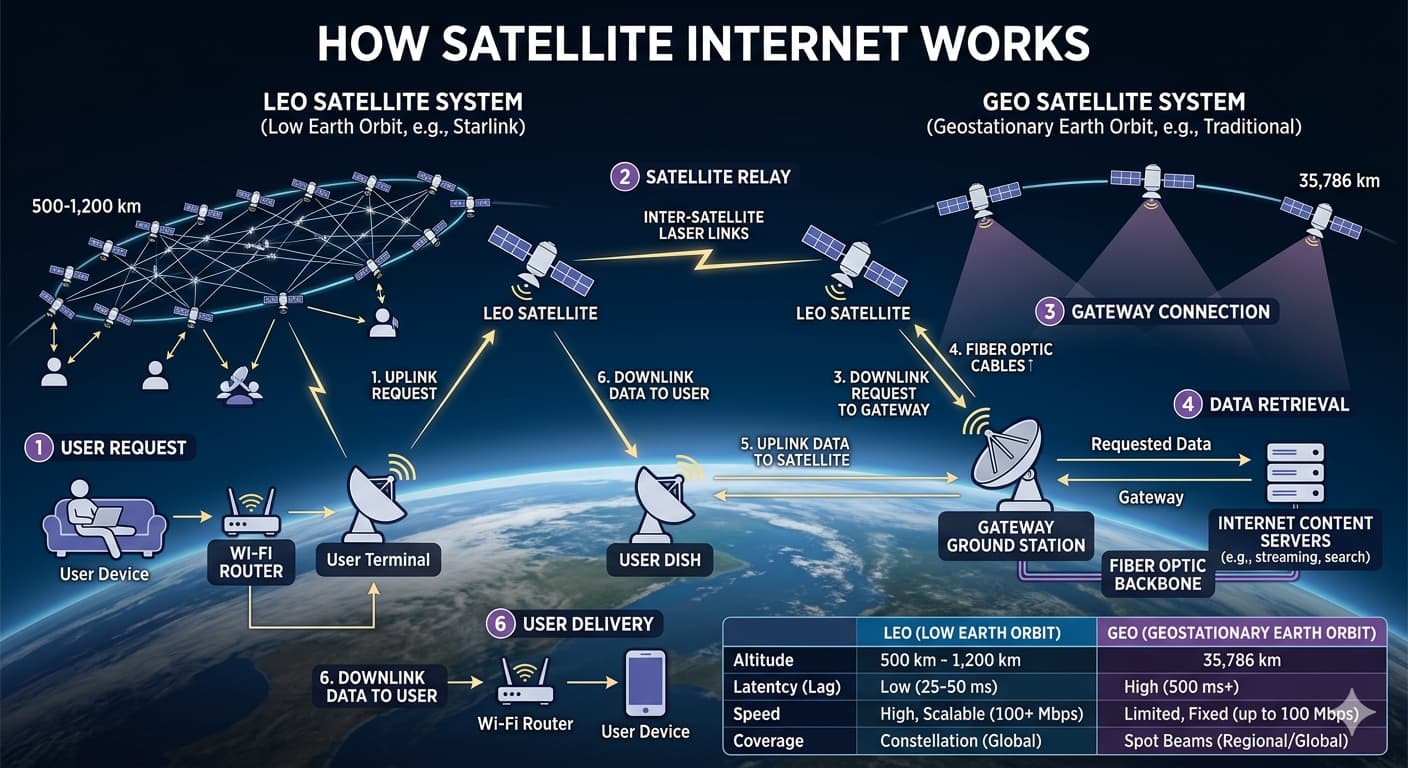
Modern systems use something called Low Earth Orbit (LEO) satellites. These satellites stay much closer to Earth compared to older satellite systems.
That shorter distance matters a lot.
It helps reduce delay, which means websites load faster and video calls feel smoother. Older satellite internet had a reputation for being slow. The newer systems are trying hard to fix that image.
Types of Satellite Internet
1. Traditional (Geostationary Satellites)
This is the older version of satellite internet.
The satellites stay very far from Earth and remain fixed in one position. Because of that long distance, signals take more time to travel back and forth.
You usually notice that delay during gaming or video calls.
2. Modern (LEO Satellites)
This is the newer approach.
LEO satellites are much closer to Earth, so the connection feels faster and more responsive. Services like Starlink are built around this idea.
In many cases, speeds can reach around 50–200 Mbps depending on location and network traffic.
That’s a huge improvement compared to older satellite systems.
Key Benefits of Satellite Internet
The biggest advantage is simple: availability.
Fiber cables can take years to reach remote places, but this skips that problem completely.
A few other benefits stand out, too:
- Works in rural and remote locations
- Doesn’t depend on local cable infrastructure
- Setup is usually straightforward
- Useful during emergencies or network outages
It’s also becoming popular with travelers and people who work remotely from different places.
Honestly, the idea of having internet access almost anywhere still feels a little futuristic.
Limitations You Should Know
Satellite internet isn’t perfect, and it’s better to know that upfront.
The weather can still affect the connection sometimes. Heavy rain or storms may reduce signal quality. The equipment can also be expensive at first.
You’ll also need a clear view of the sky. If tall buildings or trees block the dish, the connection may not work properly.
And in countries like India, availability is still expanding. Some services are approved in limited phases, while others are still waiting for full rollout.
So yes, the technology is exciting. But it’s still evolving
Satellite Internet Pricing (Global + India Breakdown)
Pricing is one of the biggest questions people have.
And honestly, the answer depends heavily on where you live.
Global Pricing Overview
In many countries, monthly plans currently range between:
- $30 to $120 per month
- Roughly ₹2,500 to ₹10,000 in Indian currency
The hardware setup can cost anywhere from:
- $199 to over $2,000
- Around ₹16,000 to ₹2 lakh, depending on the plan and equipment
Some regions are getting lower prices as competition increases. In parts of Africa and smaller markets, satellite internet plans have already become much more affordable.
Right now, most companies are still in expansion mode. Pricing will probably keep changing over the next few year
Satellite Internet Pricing in India
India is still in an early stage, but some expected pricing details are already being discussed.
Early reports around Starlink suggested:
- Around ₹8,600 per month for service
- Around ₹34,000 for hardware setup
There are also market estimates suggesting prices could eventually settle closer to:
- ₹2,500 to ₹3,500 per month
That sounds more realistic for mass adoption in India.
Still, final pricing is not completely fixed yet. Government policies and spectrum costs will play a major role in how affordable these services become.
Satellite Internet vs Fiber vs 5G
| Feature | Satellite | Fiber | 5G |
|---|---|---|---|
| Availability | Almost everywhere | Limited | Expanding |
| Speed | Medium–High | Very high | High |
| Latency | Medium | Low | Low |
| Setup | Easy | Complex | Easy |
If you already have reliable fiber at home, it’s probably still the better option.
But that’s not really the point of satellite internet.
The real goal is to bring connectivity to places where fiber simply doesn’t exist.
Satellite Internet in India: What’s Happening
India is becoming one of the most important markets for satellite internet companies.
That’s not surprising when you think about how many rural and underserved regions still struggle with stable internet access.
Major players are already preparing for expansion:
- Starlink
- OneWeb
- Reliance Jio and its satellite ambitions
Government approvals are slowly moving forward, although regulations and pricing policies are still being finalized.
There’s a lot of competition coming into this space. That’s usually a good sign for users because competition often pushes prices down over time.
Who Should Use Satellite Internet?
Satellite internet makes the most sense for people who don’t already have good internet options.
For example:
- Rural households
- Remote workers
- Travelers
- Small businesses need backup internet

If fiber is already available in your area at a reasonable price, satellite internet may not be necessary yet.
But if your current connection constantly drops or barely works, this technology could feel like a huge upgrade.
Future of Satellite Internet
The next few years are going to be interesting.
Thousands of satellites are expected to launch globally. More companies are entering the market. Speeds will likely improve, and pricing should become more competitive over time.
Even companies outside traditional telecom are entering this space now.
That tells you something.
Satellite internet is no longer being treated like a niche experiment. It’s becoming part of the future internet infrastructure.
And honestly, it’s hard not to find that exciting.
Final Thoughts
Satellite internet probably won’t replace fiber in big cities anytime soon.
It doesn’t need to.
Its real value is reaching people who were left out for years because traditional infrastructure never reached them.
For someone living in a remote area, a stable internet connection can make a big difference. Education, remote work, online business, and even simple communication have become easier.
That’s why this technology matters more than just another tech trend.

COMMENTS