
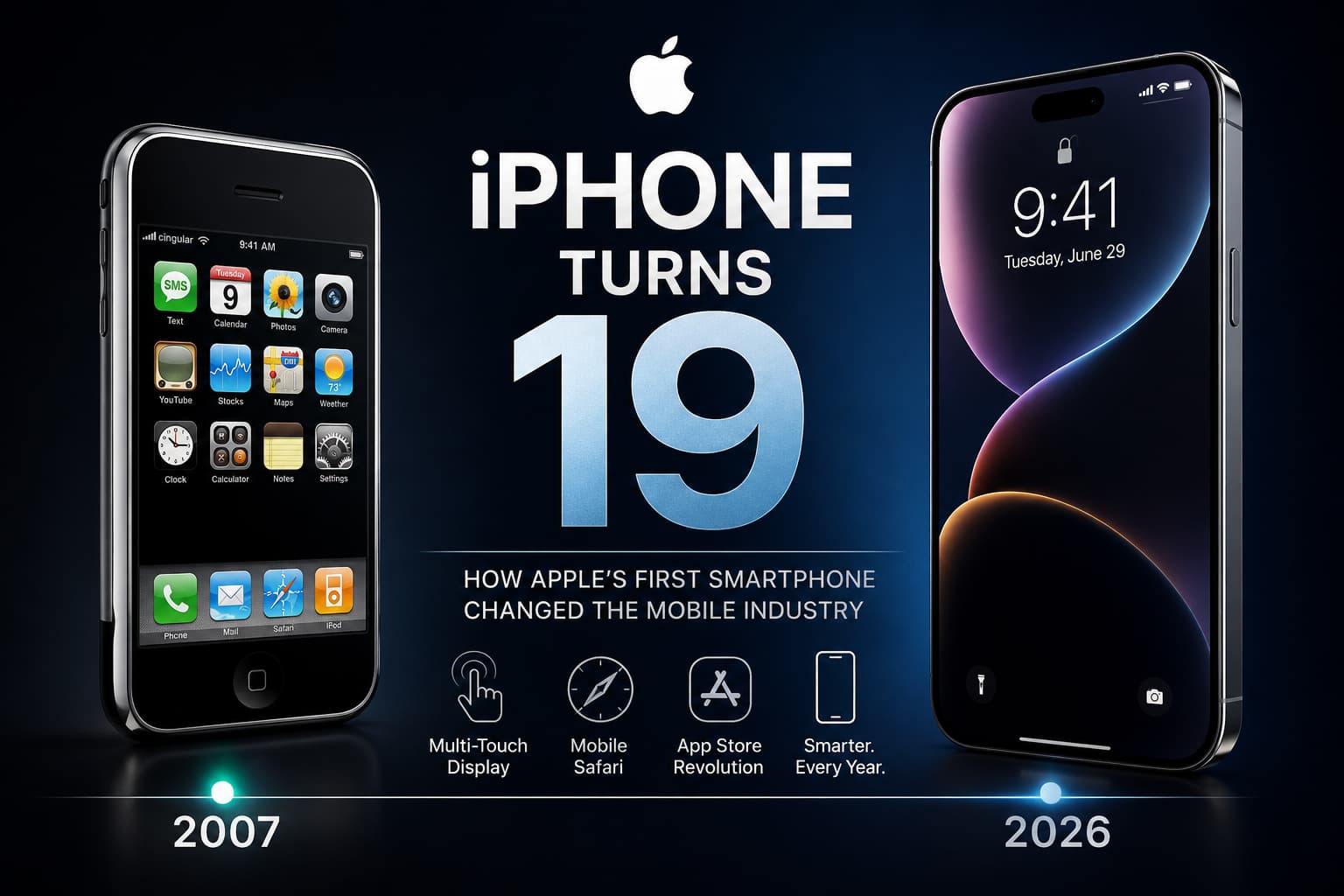
How One Device Changed the Mobile World
iPhone Turns 19, reflecting on nearly two decades of a revolutionary smartphone that has redefined the smartphone industry. The iPhone, which was introduced by Apple under Steve Jobs in January 2007, was made up of features not thought to be put in a single device.
Mobile devices before then used to serve just one purpose, which was making calls, sending texts, and browsing the internet. However, with the introduction of the iPhone in the market, mobile devices started having more features than were thought about before then. There is much that the first iPhone did differently compared to other smartphones in the market. In this paper, we shall revisit the original iPhone, learn about its innovations, and how it changed the smartphone industry 19 years ago.
Key Highlights
- The first generation of iPhone was launched by Apple in 2007.
- The product was designed as the integration of features of a phone, music player, and an internet communicator.
- Multi-touch screen technology was used, and there was no requirement to use styluses and physical keyboards.
- App Store provided a platform to software companies and entrepreneurs.
The Smartphone Industry Before the iPhone
However, before Apple, smartphones played a completely different role. Products produced by such manufacturers as Nokia, BlackBerry, Palm, and Microsoft were targeted at the business class. They mostly had either keyboard controls or resistive screens and/or a stylus, which made their usage complicated and inconvenient.
Internet browsing with these devices was difficult; websites available for mobiles were scarce, multimedia functions were minimalistic, and installing software was not easy.
Back then, the manufacturers cared about providing many buttons and business functions instead of creating an intuitive and enjoyable experience for users. The consumers tolerated that due to a lack of other options.
Apple saw the potential in reinventing the smartphone completely.
The Original iPhone Launch
On January 9, 2007, Steve Jobs gave his famous Macworld presentation in San Francisco, introducing what has become one of the most iconic consumer electronics products.
At the keynote, Steve Jobs made the following description of the product as three different things in one:
- An iPod with widescreen and touch capabilities
- A completely new mobile phone
- A unique internet communications device
As he kept repeating it, it became obvious that he meant only one product – iPhone.
The first iPhone was released on June 29, 2007. It contained 3.5 inches wide screen display, 2 megapixels camera at the back of the gadget, and 4GB or 8GB memory. Although such specs look very common nowadays, the software side of the thing was quite new for users.
Instead of concentrating only on the hardware of the product, Apple concentrated on the software and made everything very easy to understand.
Revolutionary Features That Changed Smartphones
Multi-Touch Screen
Another revolutionary change that came about with the introduction of the iPhone was the multi-touch feature. There was no need for a stylus since the user could touch the screen directly with their finger.
Gestures such as tapping, swiping, and pinch to zoom became standard in terms of interacting with the screen. This is something which is still relevant in phones up until now.
Full Screen Display
While all other smartphones were fitted with physical keyboards, Apple did away with almost every button on the front side of the device.
As a result of this large screen, there was sufficient space for browsing the web, watching videos, viewing photos, and running applications on the iPhone. This innovative design became a source of inspiration for other companies.
Desktop Class Browsing
The iPhone had a browser application called Mobile Safari, which gave users the opportunity to browse actual full websites rather than simplified mobile websites.
Visual Voicemail
Another feature that Apple brought to the table was that of Visual Voicemail. With it, the user could browse and select voicemail messages without having to listen to them one by one.
Though it may appear to be an insignificant feature in the modern context, it highlighted the company’s emphasis on enhancing ordinary activities using software design.
User Interface Made For Everyone
Probably the best feature about the iPhone was its operating system. It offered clear menus, understandable icons, and, most importantly, fluid animations when navigating through them.
In contrast to the numerous settings of other smartphones, the company paid attention to simplicity.
The App Store Changed Everything
While the original iPhone did not feature third-party applications when it was released, Apple released the App Store in 2008 and revolutionized the entire industry.
Now developers were provided with an avenue to market their applications to all parts of the globe, while users could access these applications through a few touches on their phone.
This opened up opportunities in almost every industry.
Popular categories included:
- Social media
- Mobile gaming
- Banking
- Ride-sharing
- Food delivery
- Health and fitness
- Education
- Productivity
The App Store transformed smartphones into platforms capable of supporting entire digital businesses and new career paths for developers worldwide.
How Competitors Responded
The success of Apple led to swift changes throughout the entire mobile industry.
Android was being developed at a quick pace by Google; hence, manufacturers had their own operating system that could compete with iOS.
Firms such as Samsung, HTC, Motorola, Sony Ericsson, and LG adopted large screens and applications.
In a very short period of time, the keyboard disappeared and gave way to touch screens in almost all smartphones.
Another factor that helped in speedy innovations was the competition between iOS and Android.
How the iPhone Changed the Mobile Industry
Smartphones Become General Purpose Computers
iPhone showed how the phone could take the place of several devices.
Consumers could surf the Internet, read emails, watch movies, use maps, and communicate via instant messengers on one device.
It led to a complete evolution of the phone from a means of communication to a powerful computer.
Mobile Photography Replaces Compact Cameras
With the development of cameras in smartphones in recent years, many consumers do not buy separate compact cameras anymore.
Thanks to computational photography, image processing, and advanced camera applications, smartphones have become a preferable means of photography.
Mobile Applications Develop New Industries
The success of app stores allowed the creation of whole new industries.
Ride-hailing services, food delivery services, streaming media providers, and mobile banks became possible due to the evolution of smartphones into powerful software platforms.
Tens of millions of developers depend on mobile applications.
Smartphone Design Changed Forever
Modern smartphones share many characteristics introduced or popularized by the iPhone.
These include:
- Large touchscreen displays
- Gesture-based navigation
- App-centric interfaces
- Minimal physical buttons
- Premium materials
- Regular software updates
Even manufacturers that compete directly with Apple continue to adopt design ideas that originated with the original iPhone.
The Evolution of the iPhone Over 19 Years
| Year | Milestone |
|---|---|
| 2007 | Original iPhone introduced |
| 2008 | App Store launches |
| 2010 | Retina Display debuts |
| 2011 | Siri virtual assistant introduced |
| 2014 | Larger-screen iPhones released |
| 2017 | Face ID replaces Touch ID on flagship models |
| 2020 | Apple introduces 5G connectivity |
| 2023 | USB-C replaces Lightning on flagship iPhones |
| 2025-2026 | Apple expands AI-powered features through Apple Intelligence |
This steady evolution demonstrates Apple’s continued focus on refining both hardware and software while adapting to changing user expectations.
Challenges Along the Way
The iPhone’s journey has not been without criticism.
Over the years, Apple has faced questions regarding:
- Rising smartphone prices
- Battery longevity
- Device repairability
- App Store policies
- Regulatory scrutiny
- Strong competition from Android manufacturers
Despite these challenges, the iPhone has remained one of the world’s most successful consumer technology products.
Why the Original iPhone Still Matters in 2026
19 years since the launch of the phone, most of the features that were first presented by the original iPhone are still at the forefront of modern-day smartphones.
Touchscreens, mobile applications, digital wallets, artificial intelligence assistants, face recognition, and integrated software ecosystems all owe their development to Apple’s initial design philosophy.
Even though today’s smartphones have evolved to become much more powerful than in 2007, the overall user experience has remained very much the same.
Despite advancements such as artificial intelligence, foldable phones, and spatial computing, even the newest generation of smartphones continues to bear the DNA of the original iPhone.
Looking Ahead: The Future Beyond 19 Years of iPhone
Even though the iPhone may not have been the first smartphone ever made, it was the one smartphone that changed how all smartphones were used and made them popular with everyone. With innovative hardware and software, Apple changed the game and revolutionized the whole industry of smartphones.
After the iPhone turned 19, its influence goes far beyond the Apple product itself. From touchscreens, app stores, and photo capabilities to AI, the technologies implemented almost 20 years ago will continue to shape the future of personal technology. No matter if you use Apple or Android devices, you cannot underestimate the influence of the iPhone.
Frequently Asked Questions
When was the first iPhone released?
The original iPhone was officially released on June 29, 2007, after being announced earlier that year on January 9.
Who introduced the first iPhone?
Apple co-founder Steve Jobs unveiled the original iPhone during his keynote presentation at Macworld 2007.
Why was the original iPhone revolutionary?
It introduced a multi-touch interface, a full-screen design, intuitive software, and later inspired the App Store ecosystem that transformed smartphones.
Was the iPhone the first smartphone?
No. Smartphones from companies like Nokia, BlackBerry, Palm, and Microsoft existed before the iPhone. However, Apple redefined the smartphone experience for mainstream consumers.
How has the iPhone influenced modern smartphones?
Modern smartphones adopted many concepts popularized by the iPhone, including touchscreen displays, app ecosystems, gesture navigation, mobile photography, and software-focused user experiences.

COMMENTS