
Why NVIDIA Thinks AI Belongs on Your PC
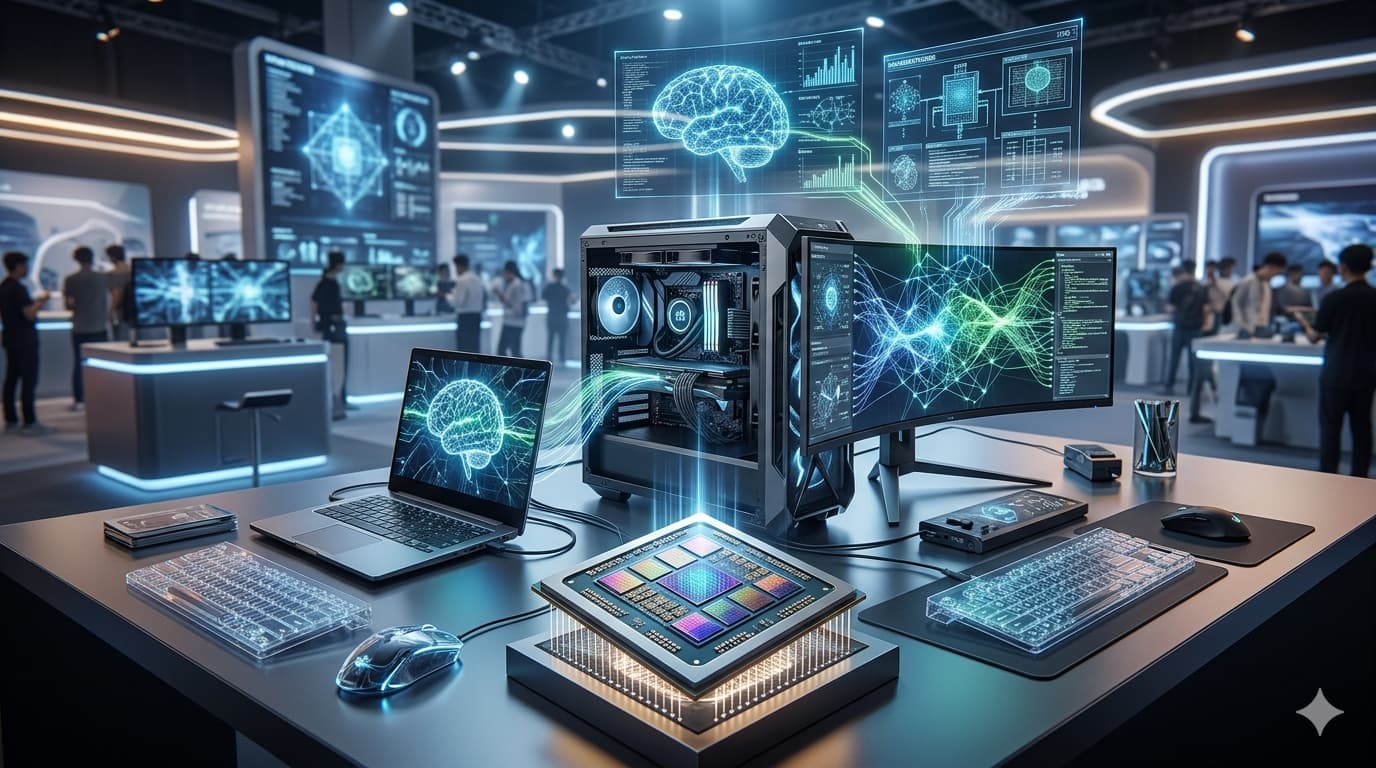
For the past few years, the AI boom has mostly been a cloud story. That’s why NVIDIA AI PCs are getting a lot of attention now. At Computex 2026, NVIDIA unveiled new hardware to bring more AI processing directly to personal computers, rather than relying entirely on remote data centers.
On the surface, it may look like another chip launch. NVIDIA introduces new hardware regularly. The bigger story is what the company aims to achieve. Instead of treating PCs as simple devices that connect to cloud-based AI services, NVIDIA wants them to become powerful AI platforms themselves.
Instead of treating PCs as simple endpoints connected to cloud AI services, NVIDIA wants them to become AI platforms in their own right.
It’s an ambitious idea. Whether it succeeds is another question entirely.
What NVIDIA Announced at Computex 2026
NVIDIA arrived at Computex with a clear message: AI belongs on the PC.
The company unveiled new technologies, including its Vera CPU and updated RTX AI capabilities. Together, they’re designed to handle AI workloads locally rather than relying entirely on cloud infrastructure.
That doesn’t mean NVIDIA wants to replace cloud computing. There’s no realistic scenario where giant AI models stop running in data centers anytime soon. Training advanced models still requires enormous amounts of computing power.
What NVIDIA is suggesting is something more practical.
Many everyday AI tasks don’t need thousands of GPUs sitting in a server farm. They can run much closer to the user.
That’s where the company sees an opportunity.
NVIDIA also discussed software partnerships and ecosystem support. That’s important because hardware alone doesn’t create a market. Developers need to build applications that leverage these capabilities. PC manufacturers need to include them in future products.
The company appears to understand that challenge. This wasn’t presented as a single product launch. It was presented as the beginning of a larger shift.
What Is an AI PC?
The term “AI PC” is among the most overused in technology.
NVIDIA’s latest strategy is built around the idea of the AI PC, a new category of computers designed to handle artificial intelligence workloads more efficiently.
Every major chipmaker seems to have its own definition.
At its simplest, an AI PC is a computer built with hardware specifically designed to accelerate AI workloads. That means tasks such as image generation, language processing, transcription, content creation, and AI assistants can run more efficiently.
The concept sounds technical, but most users won’t care about the engineering details.
They’ll care about the outcome.
Does the laptop feel faster?
Can applications respond instantly?
Do AI features work without needing a constant internet connection?
Those are the questions that matter.
In many ways, this reminds me of how smartphones evolved. Years ago, features such as voice recognition depended heavily on cloud processing. Over time, more of that work moved onto the device itself.
Nobody talks about that transition anymore because it has become normal.
NVIDIA AI PCs are betting that the same thing can happen with PCs.
Why NVIDIA Wants AI to Run on the Device
Speed is probably the easiest benefit to understand.
Every time an AI request travels to a remote server and back, there’s a delay. Sometimes it’s barely noticeable. Sometimes it isn’t.
Local processing removes much of that waiting.
Privacy may be an even bigger selling point.
Many businesses are hesitant to send sensitive information to external AI systems. Legal documents, financial records, internal communications, and proprietary data all come with risks. Running AI directly on a device can help address some of those concerns.
Then there’s cost.
Cloud AI isn’t free. As organizations increase their use of AI, cloud expenses can grow quickly. If even a portion of those workloads can run locally, the economics start looking a lot more attractive.
Of course, data centers aren’t going away. That’s not what NVIDIA is arguing.
The company believes the balance will change.
A few years from now, people may be surprised by how much AI work happens directly on their laptops.
Industry analysts expect AI PCs trends to accelerate as more hardware makers introduce devices built specifically for AI workloads.
Key Features of NVIDIA’s New AI Platform
RTX AI Acceleration
RTX technology has long been associated with gaming and graphics.
Now, NVIDIA wants people to think about it differently.
AI workloads are very good at leveraging the parallel processing capabilities of modern GPUs. That’s one reason NVIDIA has become so dominant in the AI market.
The company’s latest RTX AI technologies are designed to make those capabilities more accessible on consumer and business PCs.
It’s not the flashiest part of the announcement, but it may end up being one of the most important.
Local Large Language Models
This is where things start getting interesting.
Most people interact with large language models through cloud-based services. You send a prompt. A server processes it. The answer comes back.
NVIDIA believes more of those interactions can happen locally.
Imagine opening an AI assistant without worrying about server availability. Or using AI tools on a flight with limited internet access. Those scenarios become much more realistic when language models can run directly on the device.
There are still limitations, of course. Local models won’t replace the largest cloud-based systems overnight.
Even so, the direction is becoming harder to ignore.
AI Content Creation Tools
Content creators are likely to be among the earliest beneficiaries.
AI has already become a major part of modern creative workflows. Writers use it. Designers use it. Video editors use it.
The difference is that many of these tools currently depend on cloud services.
Faster local processing could make creative work feel more seamless. Instead of uploading files and waiting for results, creators may be able to complete more tasks instantly.
For professionals who work with large files every day, that’s a meaningful improvement.
Enterprise AI Applications
Businesses remain one of NVIDIA’s biggest opportunities.
Companies want the productivity benefits of AI, but many are still trying to balance innovation with security and compliance requirements.
Local AI processing offers another option.
Rather than sending every request to an external service, organizations could keep more data within their own environment.
That’s unlikely to solve every concern, but it may reduce some of the barriers that have slowed enterprise adoption.
How AI PCs Could Change Everyday Computing
The most interesting technology shifts often look boring at first.
Think about Wi-Fi. Or smartphones. Or cloud storage.
None of those innovations changed everything overnight. They became important because they slowly blended into everyday life.
AI PCs may follow a similar path.
A few years from now, users might expect their devices to summarize meetings automatically, organize files intelligently, draft emails, and answer questions without needing an internet connection.
The change won’t happen all at once.
In fact, many people may not even realize it’s happening.
That’s often how successful technology works. It becomes useful before it becomes noticeable.
Gaming could see some of the biggest benefits. Productivity software will probably improve as well. Developers are already experimenting with local coding assistants and AI-powered workflows.
The demand for specialized hardware is only growing, which helps explain why AI chip demand has become one of the hottest topics in the technology sector.
Challenges Facing AI PCs
For all the excitement, there are still plenty of unanswered questions.
Price is one of them.
Consumers have become increasingly selective about upgrading their computers. Many people are holding onto devices longer than they did a decade ago.
That creates a challenge for every company promoting AI PCs.
The hardware may be impressive, but users still need a compelling reason to spend money.
Software is another concern.
The industry has spent months talking about AI PCs. What remains less clear is which applications will truly make these systems feel essential.
History is full of technologies that looked promising but struggled to find a killer use case.
NVIDIA AI PCs aren’t guaranteed to avoid that problem.
What This Means for the Future of AI
The most important part of NVIDIA’s announcement isn’t the hardware.
It’s the direction.
For years, discussions about AI have focused almost entirely on larger models, larger data centers, and larger infrastructure investments. NVIDIA itself has benefited enormously from that trend.
Now the conversation is expanding.
The industry is beginning to ask what happens when AI moves closer to the user.
That’s where AI PCs fit into the picture.
The future will almost certainly involve both approaches. Cloud systems will handle massive workloads. Personal devices will increasingly handle everyday tasks.
The exact balance remains unclear.
What seems increasingly likely is that AI won’t stay confined to distant servers forever.
A Big Bet on the Future of AI Computing
NVIDIA’s latest AI PC push feels like an attempt to shape the next chapter of the AI industry.
The company isn’t just selling chips. It’s promoting a different vision of how people interact with artificial intelligence.
Whether consumers embrace that vision remains to be seen. New categories don’t become mainstream simply because a technology company says they will.
Still, NVIDIA has a strong track record of spotting major shifts before they happen.
If the company’s bet is correct, future PCs may do far more than run software and browse the web. They could become intelligent systems capable of handling a growing share of AI tasks on their own.
That’s a future NVIDIA clearly wants to build. The rest of the industry now has to decide whether it agrees.

COMMENTS