
Pixel 11 Pro XL Benchmark Leak: What We Know
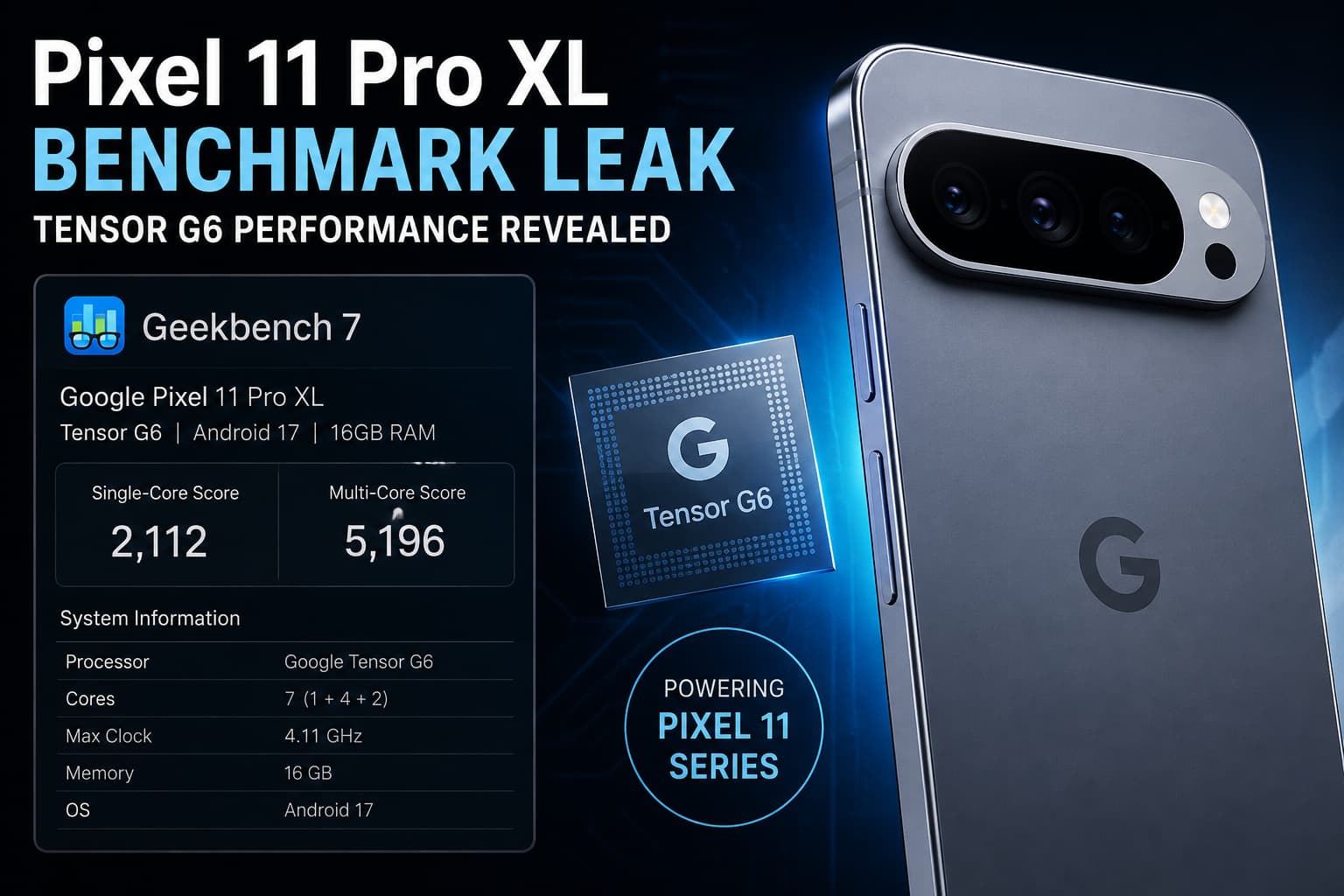
Google’s Pixel 11Pro XL has appeared in the Geekbench database just ahead of its official launch, giving us an early look at the performance of the new Tensor G6 processor. The Pixel 11Pro XL benchmark shows 2,112 points in the single-core test and 5,196 points in the multi-core test.
The numbers provide an interesting first look at Google’s next flagship smartphone. While the Tensor G6 appears to deliver a modest improvement in single-core performance, its multi-core score is raising questions about Google’s decision to use a seven-core CPU configuration.
However, this is still an early benchmark result. It should not be treated as a final verdict on the retail Pixel 11 Pro XL.
Pixel 11 Pro XL Benchmark Results
The Geekbench 7 listing identifies the device as the Google Pixel 11Pro XL, with the codename “kodiak.” It was uploaded on August 10, 2026, and the phone was running Android 17 during testing.
Here are the key results:
| Test | Pixel 11Pro XL |
|---|---|
| Geekbench 7 Single-Core | 2,112 |
| Geekbench 7 Multi-Core | 5,196 |
| Processor | Google Tensor G6 |
| CPU cores | 7 |
| Maximum clock speed | 4.11 GHz |
| RAM | 16GB |
| Operating system | Android 17 |
| Device codename | Kodiak |
The processor configuration consists of one core running at up to 4.11GHz, four cores at 3.38 GHz, and two cores at 2.65GHz.
Tensor G6 Geekbench Scores Explained
On the face of it, a score of 2,112 seems perfectly acceptable for a modern-day flagship smartphone, but it’s the 5,196 multi-core score that is the key here.
The single-core test conducted by Geekbench is mostly concerned with measuring the ability of the processor to deal with workloads relying on a single core. The multi-core test results, on the other hand, show how well the processor deals with workloads that are suitable to utilize multiple cores.
This feature makes the seven-core Tensor G6 combination especially noteworthy.
Tom’s Guide compared the leaked result of the Pixel 11Pro XL with the numbers of the iPhone 17 Pro Max and Galaxy S26 Ultra and discovered that there is a considerable gap in terms of CPU performance.
But still, these are just the benchmark scores, which do not necessarily reflect how the smartphone will work in daily routine.
How Tensor G6 Compares With Other Flagship Chips
The benchmark result of Pixel 11Pro XL does not make Tensor G6 the leader among flagships in terms of performance.
By way of comparison, according to Tom’s Guide, the iPhone 17 Pro Max achieved Geekbench 7 scores of 2,995 in single-core and 8,562 in multi-core, while the Galaxy S26 Ultra scored 2,808 and 10,212, respectively.
| Smartphone | Single-Core | Multi-Core |
| Pixel 11Pro XL | 2,112 | 5,196 |
| iPhone 17 Pro Max | 2,995 | 8,562 |
| Galaxy S26 Ultra | 2,808 | 10,212 |
Thus, when comparing these data, it becomes clear that the Pixel smartphone loses to its rivals in CPU performance.
It is particularly obvious in the case of multi-core processing. If one compares the multi-core score of the Pixel 11 Pro XL with the result of the Galaxy S26 Ultra published by Tom’s Guide, it
Why Google Doesn’t Chase Benchmark Scores
Google’s Tensor strategy has never been solely about winning benchmark charts.
Instead, Google has used Tensor as the foundation for Pixel-specific features involving artificial intelligence, computational photography, voice processing and other software experiences.
That strategy appears to continue with Tensor G6.
Current information about the chip points to improvements in on-device AI processing and power efficiency, even though sustained high-performance workloads such as gaming may remain an area where the Tensor platform trails some competitors.
This is an important distinction.
A phone can lose a benchmark comparison while still offering a smooth everyday experience if its software, thermal management, and AI acceleration are well optimized.
What the Benchmark Means for Gaming
Games would be an exciting way to test the Pixel 11 Pro XL.
This is because a leaked Geekbench entry reveals the existence of a PowerVR C-Series GPU, while another entry on Geekbench 6 for compute yields a score of 7,757 on OpenCL for the phone.
While this tells us something about compute performance for graphics, it does not reveal exactly how well games will run.
There is a lot that goes into gaming beyond benchmarks. The architecture of the GPU, the drivers, thermal constraints, game optimizations, and sustained clock speeds are only a few of those.
As such, gamers should await independent testing before concluding its graphics capabilities.
Pixel 11 Pro XL Expected Features
Pixel 11 Pro XL appears to be marketed as Google’s high-end flagship smartphone in the Pixel 11 lineup.
As per the current specifications, the smartphone has a 6.8-inch LTPO OLED screen with a 120Hz refresh rate, triple rear cameras, a 42MP front camera, and a 5,115 mAh battery with a 45-watt wired charger.
The smartphone comes with 12GB/16GB of RAM and 256GB/512GB storage options.
These specs imply that Google will continue with its strategy of marketing Pro XL as a premium camera, AI, and productivity smartphone rather than a gaming smartphone
Should You Be Concerned About Tensor G6?
Not necessarily.
The leaked benchmark is certainly interesting, especially because the multi-core score looks weak compared with other flagship processors. But there are several reasons not to jump to conclusions.
First, Geekbench results can vary depending on firmware, thermal conditions, and background processes.
Second, this is an early result rather than a large collection of retail-device benchmarks.
And third, Google’s Tensor chips are designed around a broader strategy that includes AI and Pixel-exclusive software capabilities.
In fact, subsequent Geekbench results shared after launch reportedly showed higher numbers for the Pixel 11 series, suggesting that the original result may not represent the final performance ceiling.
That makes the first leaked benchmark useful as an early indicator, but not a definitive performance assessment.
What the Pixel 11 Pro XL Benchmark Really Tells Us
The most interesting takeaway from the Pixel 11Pro XL benchmark isn’t simply that Tensor G6 loses to competing flagship chips.
It highlights Google’s continued approach to smartphone silicon.
Google appears willing to sacrifice some raw CPU benchmark performance in exchange for a chip designed around AI, photography, efficiency, and Pixel-specific experiences.
That strategy can work, provided the real-world experience matches Google’s ambitions.
The bigger question is whether Tensor G6 can deliver enough performance for demanding users while keeping the Pixel 11 Pro XL efficient and thermally stable.
We’ll need extended testing to answer that.
What the Pixel 11 Pro XL Benchmark Means
The leaked Pixel 11Pro XL benchmark gives us an early look at Google’s Tensor G6, and the results are mixed. The phone recorded 2,112 single-core and 5,196 multi-core points in Geekbench 7, with the tested device featuring 16GB of RAM and a seven-core processor configuration.
The numbers suggest that Tensor G6 may still trail Apple’s and Qualcomm-powered flagship competitors in raw CPU performance.
But benchmarks aren’t the whole story.
Google’s real advantage could come from the combination of Tensor G6, Android 17, Pixel-exclusive AI features, and Google’s computational photography technology. Until more retail devices are tested, it’s too early to declare the Pixel 11 Pro XL either a performance disappointment or a major success.
For now, the Tensor G6 benchmark gives us one clear message: Google still seems to be playing a different game from companies focused primarily on benchmark performance.
Frequently Asked Questions
What is the Pixel 11 Pro XL Geekbench score?
The leaked Geekbench 7 listing shows 2,112 points in single-core and 5,196 points in multi-core performance.
What processor does the Pixel 11 Pro XL use?
The Pixel 11 Pro XL uses Google’s Tensor G6 processor. The leaked Geekbench listing shows a seven-core CPU with a maximum clock speed of 4.11GHz.
How much RAM does the Pixel 11 Pro XL have?
The leaked benchmark device was equipped with 16GB of RAM.
Is Tensor G6 faster than Snapdragon?
The leaked benchmark does not suggest that Tensor G6 will beat leading Snapdragon processors in raw CPU performance. However, real-world performance also depends on software optimization, AI acceleration, thermals and sustained performance.
Is the Pixel 11 Pro XL good for gaming?
It is too early to give a definitive answer based on leaked benchmarks alone. Independent gaming and thermal tests will provide a much better indication of sustained gaming performance.
When will the Pixel 11 Pro XL be available?
Google officially unveiled the Pixel 11 series on August 12, 2026, with the Pixel 11 Pro XL listed for release on August 20.

COMMENTS